
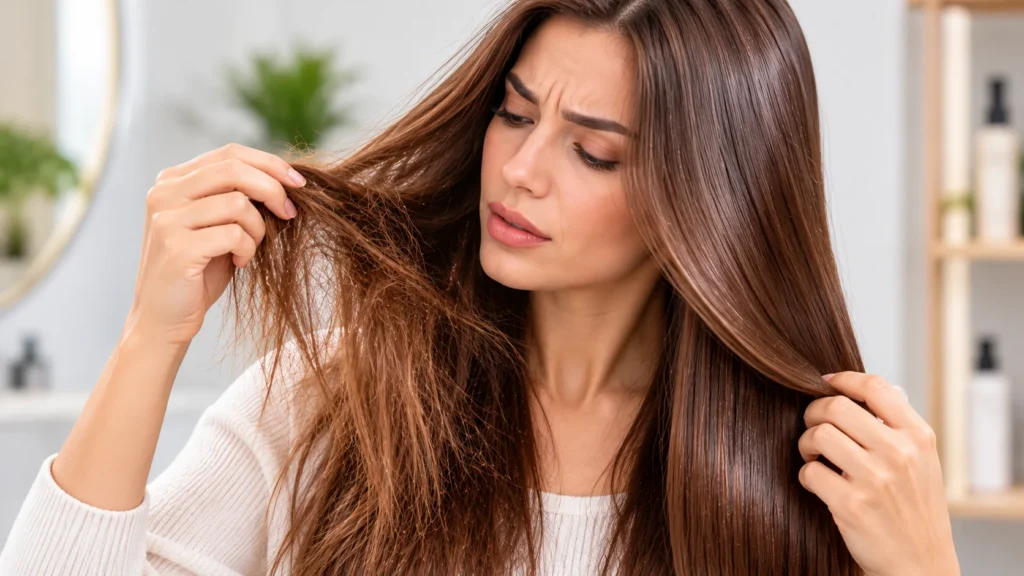
Hair damage caused by bleaching, coloring, heat styling, and environmental exposure can gradually affect the strength, elasticity, and appearance of the hair fiber. While traditional conditioners mainly improve softness and manageability, newer treatments aim to address damage within the hair structure.
Molecular hair repair is one of these approaches, using specialized ingredients and delivery technologies to improve the condition of weakened strands. For salon professionals and consumers exploring advanced hair care, understanding how these treatments work is essential. This guide for Salomio explains the science, ingredients, benefits, application methods, and limitations of molecular hair repair.
What Is Molecular Hair Repair and What Does It Do?
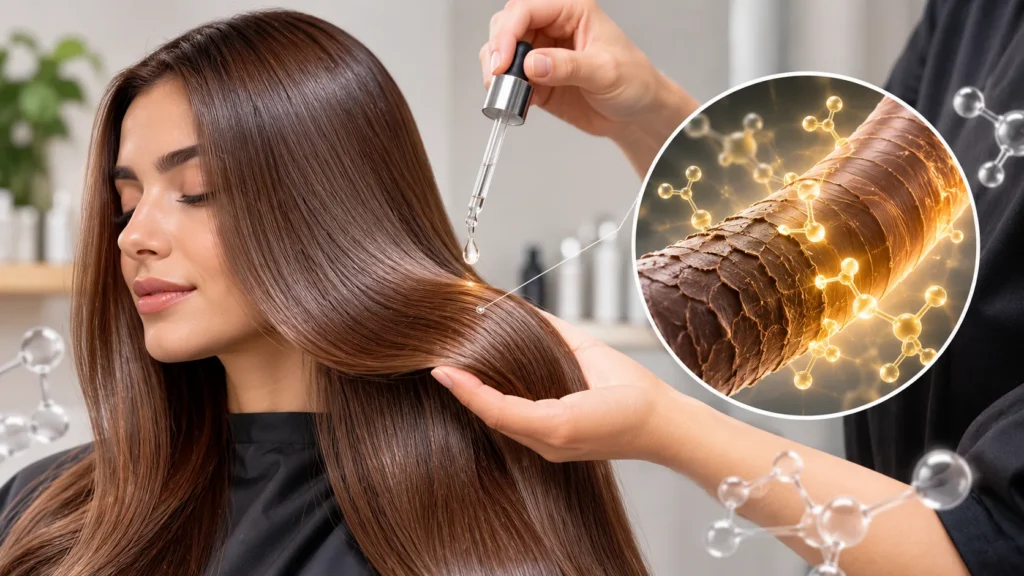
Molecular hair repair refers to a category of hair care treatments designed to improve damaged hair by targeting components of the hair fiber, rather than focusing exclusively on its outer surface. Depending on the product, formulations may use peptides, amino acids, proteins, and conditioning agents to support the hair’s structure and improve its physical properties. The term is not a single standardized treatment or universally defined technology. Different brands use different formulas and mechanisms, so understanding the ingredients and evidence behind a specific product is more useful than relying on its marketing name.
How Is Molecular Hair Repair Different from Regular Conditioning?
Traditional conditioners primarily improve the hair’s surface properties. They deposit conditioning ingredients that smooth the cuticle, reduce friction, improve detangling, and make strands feel softer. Molecular repair products may also provide these benefits, but some are formulated to interact with the inner hair fiber using smaller molecules or specialized ingredients.
The distinction depends on the formulation. A product described as molecular repair may contain peptides or amino acids intended to support damaged protein structures, while another may rely mainly on conditioning polymers and proteins that improve the hair’s feel. Therefore, the term does not automatically guarantee deeper or more permanent repair. Professionals should examine product technology, ingredient lists, and available performance testing before recommending a treatment.
How Does Molecular Hair Repair Work on Damaged Hair?
To understand molecular hair repair, it helps to examine the structure of a hair strand. Hair is primarily made of keratin, a structural protein organized into complex arrangements. The cortex provides much of the fiber’s strength and elasticity, while the outer cuticle protects the inner structure. Chemical treatments, excessive heat, friction, and ultraviolet exposure can weaken these components. Molecular repair technologies aim to improve selected properties of damaged fibers through ingredients that interact with proteins, reinforce weakened areas, or condition the surface.
What Happens to Hair at the Molecular Level?
Hair contains keratin proteins made from amino acids connected through peptide bonds. Its mechanical properties also depend on several interactions, including hydrogen, ionic, and disulfide bonds. These structures help determine how hair responds to stretching, moisture, and external stress.
In their 2024 review, researchers S. Breakspear, B. Nöcker, and C. Popescu explain that “the picture of chemical bonding in hair appears to be far from a homogeneous one.” This highlights why hair damage and repair cannot be reduced to one simple mechanism. Different treatments affect different structures, and results depend on the type and location of the damage.
Molecular repair formulations may use peptides, amino acids, or other functional ingredients to interact with weakened areas of the fiber. However, the exact mechanism varies between technologies, and not every product has been independently demonstrated to rebuild internal bonds.
What Role Do Peptides and Amino Acids Play?
Peptides are short chains of amino acids, which are the building blocks of proteins such as keratin. In hair care, selected peptides and amino acids are used in formulations intended to support the condition of damaged fibers. Their effectiveness depends on molecular size, formulation, concentration, and the ability of ingredients to interact with the hair.
For example, L’Oréal Professionnel describes its Absolut Repair Molecular technology as using peptide bonders and five amino acids to target damaged hair fibers. This is a brand-specific technology rather than a universal explanation for every molecular repair treatment. Other products may use hydrolyzed proteins or different conditioning systems.
Research by Fernandes and colleagues also emphasizes the structural role of keratin. Their review explains that “the resulting crosslinked structure of keratin is responsible for the shape, structure, and strength of the hair fibers.” This provides useful scientific context for why treatments targeting hair proteins and their interactions have become an important area of cosmetic research.
What Ingredients Are Used in Molecular Hair Repair Treatments?
Molecular hair repair products do not all share the same ingredient list. Some focus on peptide-based technologies, while others combine amino acids, hydrolyzed proteins, conditioning agents, and protective ingredients. For salon professionals, understanding the function of these components helps with product selection and client recommendations. It is also important to distinguish ingredients intended to support the hair fiber from those primarily responsible for softness, shine, and easier styling.
Which Ingredients Support the Hair Repair Process?
Common ingredients found in advanced repair formulas include:
- Peptides: Short amino acid chains used in some technologies to interact with damaged hair proteins.
- Amino acids: Protein building blocks that may help support hair conditioning and targeted repair formulations.
- Hydrolyzed proteins: Smaller protein fragments that can deposit on or interact with the hair fiber, improving its feel and reducing the appearance of damage.
- Conditioning polymers: Ingredients that smooth the cuticle, reduce friction, and improve manageability.
- Silicones and emollients: Components that help improve shine, softness, and protection against everyday friction.
Not every ingredient works at the same structural level. For example, conditioning polymers may produce an immediate improvement in smoothness without rebuilding internal protein structures. Product evaluation should therefore consider both the ingredient function and the manufacturer’s supporting evidence.
What Are the Benefits of Molecular Hair Repair and Who Should Use It?
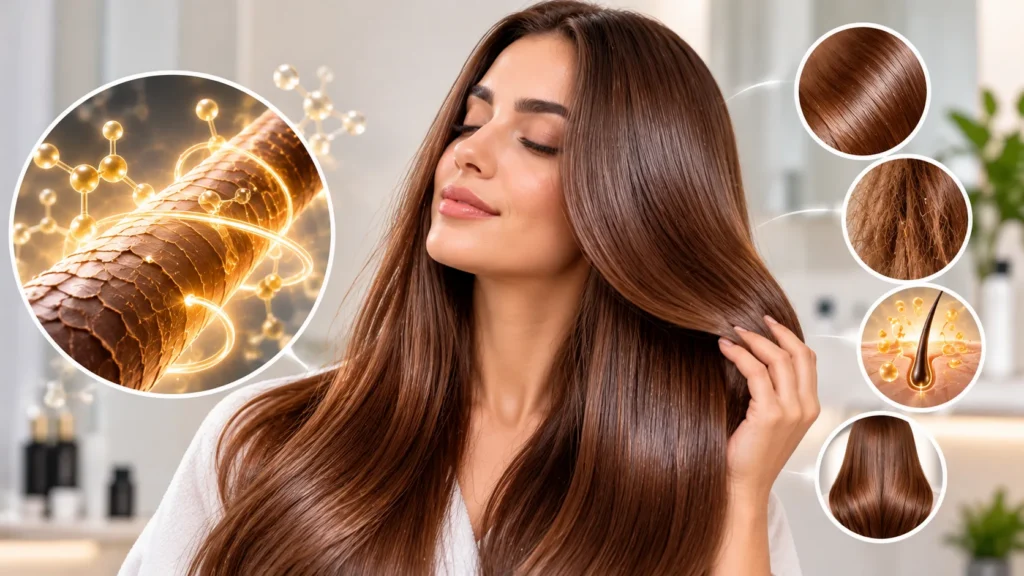
Molecular hair repair treatments are generally marketed for weakened, chemically treated, or heat-damaged hair. Their potential benefits depend on the formula and the condition of the hair before treatment. Some products aim to improve strength-related properties, while others focus on smoothness, elasticity, shine, and reduced breakage during grooming. These treatments may be useful in professional hair care routines, but they should not be presented as a complete or permanent solution for every type of damage.
Is Molecular Hair Repair Suitable for Bleached and Color-Treated Hair?
Bleaching and coloring can alter the hair’s chemical structure, affect protective surface components, and increase porosity. Repeated chemical processing may also leave strands weaker and more vulnerable to breakage. Molecular repair products designed for damaged hair may help improve manageability, reduce friction, and support the condition of these fibers.
They can be particularly relevant for clients who frequently lighten their hair or combine coloring with heat styling. However, suitability depends on the product instructions and the level of damage. A professional should assess elasticity, porosity, breakage, and previous chemical services before choosing a treatment. Severely compromised hair may require a more conservative service plan, including reduced chemical processing and careful trimming of irreversibly damaged ends.
What Are the Limitations of Molecular Hair Repair?
One important limitation is that a hair shaft is not living tissue. In their 2023 review, Fernandes and colleagues explain that “hair cannot be biologically repaired.” Cosmetic treatments can improve its physical condition, protect exposed areas, and temporarily or progressively improve measurable properties, but they cannot make an existing strand biologically regenerate.
Results also vary according to the formula, application method, hair history, and frequency of use. A treatment may improve softness and reduce breakage without restoring every damaged structure. Claims such as permanent reconstruction or complete reversal of years of damage should be evaluated carefully, particularly when they are based only on brand-sponsored testing.
How Is Molecular Hair Repair Applied and How Does It Compare with Bond Repair?
Molecular hair repair can be offered as a professional salon service or as part of an at-home hair care routine. The application process depends on the product system: some treatments require a pre-treatment and rinse-off serum, while others are designed as masks or leave-in products. Professionals should always follow the manufacturer’s instructions rather than applying one universal protocol to every formula. Understanding the difference between molecular repair and bond repair also helps clients choose products that match their hair concerns.
How Is a Molecular Hair Repair Treatment Applied?
The following is a general How-to guide for a product system that is designed for layered application. Exact steps and processing times must follow the manufacturer’s instructions.
- Assess the hair: Check the level of dryness, breakage, porosity, and previous chemical processing.
- Cleanse the strands: Use the recommended shampoo to remove residue and prepare the hair.
- Apply the repair treatment: Distribute the specified serum or treatment evenly through the lengths and ends.
- Follow the processing instructions: Respect the recommended application time and whether the product should be rinsed.
- Condition and protect: Apply the recommended mask or leave-in product to improve softness and reduce friction.
- Style carefully: Use appropriate heat protection and avoid unnecessary high-temperature styling.
For salon services, sectioning the hair and distributing products evenly can help achieve consistent coverage. Professionals should also explain realistic results and recommend an appropriate maintenance routine.
How Does Molecular Hair Repair Compare with Bond Repair?
The terms molecular repair and bond repair are sometimes used interchangeably in marketing, but they do not necessarily describe identical technologies. Bond repair generally refers to products designed to target or support specific interactions within the hair fiber. Molecular repair is a broader term that may include peptide-based technologies, amino acids, proteins, and other ingredients.
| Treatment | Main Focus | Typical Benefit |
|---|---|---|
| Molecular Hair Repair | Selected components of the hair fiber | Improved strength-related properties and hair condition |
| Bond Repair | Specific bonds or interactions | Support for weakened hair structure |
| Deep Conditioning | Hair surface and moisture-related properties | Softness, smoothness, and manageability |
| Protein Treatment | Protein-based conditioning | Improved feel and reduced appearance of weakness |
These categories can overlap. Some molecular repair products may also function as bond-building treatments, while some bond repair products provide conditioning benefits.
Conclusion
Molecular hair repair represents an evolving area of professional hair care, combining advances in cosmetic formulation with a better understanding of hair fiber structure. Depending on the technology, these treatments may help improve strength-related properties, smoothness, elasticity, and manageability. However, their results should be evaluated according to the specific formula rather than broad marketing claims.
For salon professionals, the best approach is to assess each client’s hair condition, select evidence-supported products, and combine treatments with appropriate aftercare. Salomio encourages beauty professionals to stay informed about emerging hair technologies and make recommendations based on realistic results.
Comments