
Choosing between a hair mask and conditioner is not simple for many people because both products are used to improve the appearance and manageability of the hair, but they do not have the same role. The difference between a hair mask and conditioner is mainly determined by their purpose, level of care, method of use, and the needs of the hair. Conditioner is usually part of a regular hair-washing routine and helps soften the hair, detangle it, and make it more manageable.
A hair mask is generally used as a more targeted and complementary form of hair care. The American Academy of Dermatology also emphasizes that hair care products should be selected according to the type and condition of the hair. At Salomio, understanding these differences can help salons and beauty professionals provide more accurate recommendations to their clients.
What Exactly Is the Difference Between a Hair Mask and Conditioner?
The most important difference between these two products is their role in a hair care routine. Conditioner is usually used after shampooing to make the hair softer and easier to comb. In contrast, a hair mask is generally designed for complementary and targeted care of the hair shaft and, depending on the product formula, may be used for dry, damaged, colored, or frizzy hair.
However, it is not possible to judge a product’s performance based on its name alone; the formulation and usage instructions on the packaging are very important. Therefore, instead of considering one universally better than the other, we should determine what type of care the hair actually needs.
What Does a Hair Mask Do for the Hair Shaft?
A hair mask is generally a product intended for complementary care of the hair shaft. These products may be formulated in different ways, and depending on their ingredients, their purpose can range from conditioning and reducing dryness to improving the feel and appearance of the hair.
An important point is that the term “hair mask” is not a single standard that applies to all products on the market. Some masks focus more on conditioning and the appearance of hydration, while others are designed for damaged hair or hair affected by coloring and heat. Therefore, consumers should pay attention to the claims on the packaging, ingredients, and usage instructions.
Hair masks are generally not designed for daily use, but the appropriate frequency should be determined according to the product’s own instructions and the needs of the hair. If the hair feels heavy, greasy, or flat after use, the product formula may not be suitable for that hair type.
What Role Does Conditioner Play in Daily Hair Care?
Conditioner is usually one of the main components of a hair-washing routine. The American Academy of Dermatology recommends using conditioner after washing the hair because conditioner helps moisturize the hair, detangle it, and make it more manageable. For straight or fine hair, focusing the product on the mid-lengths and ends can help prevent the roots from becoming weighed down, while dry or curly hair may need conditioner applied to a greater length of the hair shaft.
For this reason, conditioner mainly serves as “routine care,” while a hair mask is generally used as a complementary step. However, the intensity of the effect and the method of use depend on the product formula, and not all conditioners or masks can be placed into exactly the same category.
What Is the Difference Between a Hair Mask and Conditioner in Terms of Use and Frequency?
Simply put, conditioner is mainly used for regular care after washing, while a hair mask is used for more targeted care of the hair shaft. This does not mean that a mask is always “stronger” or a conditioner is always “weaker,” because the formulas of different products vary.
The American Academy of Dermatology also emphasizes choosing products that are appropriate for the hair type in its hair care recommendations. For example, fine hair generally needs lighter products so that the hair does not look weighed down.
Therefore, when comparing these two products, consider four factors: the purpose of the product, hair type, usage instructions, and the result you expect.
Is a Hair Mask Better Than Conditioner, and Can They Replace Each Other?
The short answer is that neither is universally better. Hair masks and conditioners are not designed for exactly the same purposes, and the choice between them should be based on the condition of the hair. For many people, conditioner can be part of their regular washing routine, while a hair mask can be used as complementary care when the hair needs additional conditioning.
Some people may not need a hair mask at all, and a suitable conditioner may be enough for their everyday needs. Therefore, instead of creating a complicated routine, it is better to first determine the hair’s actual needs.
Can a Hair Mask Replace Conditioner?
In some routines, a hair mask may be the only conditioning product used, but this approach cannot be recommended for everyone. The reason is that masks are generally designed to be used at a specific frequency and in a specific way, and some may not be suitable for frequent use.
Regular conditioners are designed for use after washing and their purpose is to help soften and improve the manageability of the hair. The AAD also considers using conditioner after washing to be part of proper hair care.
If someone has fine or straight hair, excessive use of heavy products may make the hair look flat. In contrast, dry, curly, or thick hair may need more care. Therefore, replacing one of these products with the other should be based on the product formula and the condition of the hair.
When Is Conditioner the More Appropriate Choice?
If your main goal is to make your hair easier to comb after shampooing, reduce tangles, and achieve greater softness and manageability, conditioner is generally the more practical choice.
The AAD recommends choosing conditioner according to hair type. For straight or fine hair, applying more of the product to the ends may be appropriate, while dry or curly hair may need conditioner applied to a larger portion of the hair shaft.
Also, if the hair is prone to becoming greasy or flat, the amount of product matters. Using more than necessary does not necessarily produce better results. In fact, the goal of conditioner is to create a balance between softness and manageability without making the hair feel heavy.
When Is a Hair Mask a More Practical Choice?
A hair mask can be more useful when, in addition to normal conditioning, the hair needs complementary care for the hair shaft. For example, hair that is prone to dryness and frizz due to coloring, heat, dryness, or natural curls may benefit from a care product suited to these needs.
However, a hair mask is not a medical treatment for hair damage, and you should not expect a cosmetic product to solve every hair problem. If the hair has severe breakage, unusual changes, or persistent problems, the underlying cause should be evaluated.
According to dermatologist Zoe Draelos, conditioners can help reduce tangling and breakage by coating the hair shaft. Therefore, choosing a mask should be viewed as part of a complete hair care routine rather than an independent solution for every problem.
Is It Necessary to Use a Hair Mask and Conditioner at the Same Time?
No, using both at the same time is not necessary for everyone. Whether both products should be included in the same routine depends on the hair type, product formulas, and usage instructions.
If a hair mask has strong conditioning properties, using conditioner during the same wash may be unnecessary. On the other hand, some people can use conditioner during regular washing and use a mask periodically.
The important point is that using more products does not necessarily mean healthier hair. Heavy products, especially when applied to the roots or scalp, may cause product buildup or a greasy feeling in some people. The AAD even notes that some hair products containing oils can cause breakouts around the hairline in some individuals.
For Each Hair Type, Is a Hair Mask or Conditioner More Suitable?
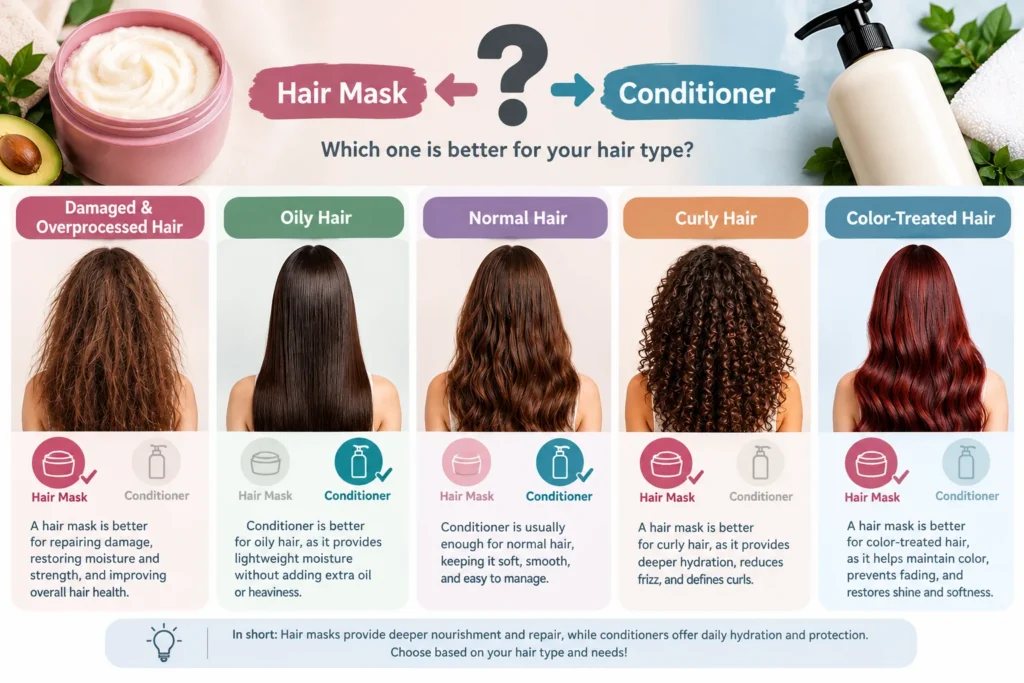
Product selection should start with the hair type and its actual needs. Fine and straight hair is generally easier to manage with lighter products, while dry, thick, or curly hair may need more conditioning. The AAD also emphasizes that products should be selected according to hair type. At the same time, you should not rely only on labels such as “nourishing,” “repairing,” or “hydrating”; the product’s usage instructions and ingredients are also important. The goal of the right choice is to create a balance between softness, manageability, hair weight, and the actual needs of the hair shaft.
Which Product Is More Suitable for Dry Hair?
Dry hair generally needs more conditioning, and choosing a suitable conditioner can be an important part of the routine. A hair mask can also be used as complementary care, especially if the product is designed for dry hair.
However, you should not assume that the thicker the product, the better the result. If the hair looks heavy and greasy after using a mask, the amount or type of product may not match the hair’s needs.
The AAD recommends that for dry or curly hair, conditioner can be applied to a greater length of the hair, while for straight and fine hair, focusing on the ends is generally more appropriate. This principle can also be considered when designing a hair care routine.
How Should You Choose Between a Hair Mask and Conditioner for Oily Hair?
For oily hair, the most important consideration is balance. An oily scalp does not necessarily mean that the hair shaft does not need conditioning; the scalp may be oily while the lengths, especially in long or color-treated hair, are dry.
For this reason, conditioning products should generally be applied mainly to the hair shaft and drier areas, while unnecessary use of large amounts of product on the scalp should be avoided.
The AAD also recommends that people with fine and straight hair apply conditioner mainly to the ends so that the hair does not become weighed down or flat. Therefore, for oily hair, choosing a lightweight product and controlling the amount used is generally more important than choosing a very heavy product.
Which Option Is More Practical for Damaged and Color-Treated Hair?
Color-treated or heat-affected hair may need additional care to maintain its appearance and manageability. In these situations, both conditioner and a hair mask can be part of the routine, but their roles are not the same.
Conditioner can be used after washing to soften the hair and detangle it, while a suitable mask can be selected as periodic complementary care.
The AAD notes that color-treated, curly, long, or heat-affected hair may benefit from additional conditioning products such as leave-in conditioner. This shows that product selection should be based on the level of care the hair needs, rather than simply labeling the hair as “damaged.”
What Product Should You Choose for Curly and Frizzy Hair?
Curly hair generally requires greater attention to moisture, tangling, and frizz management. The AAD notes that curly hair may need more conditioning than straight hair, and products formulated for curly hair can make hair easier to manage.
In such cases, conditioner can be a regular part of the washing routine, while a hair mask can be used periodically depending on the hair’s needs. The amount of product should be adjusted according to the thickness and length of the hair.
An important point for curly hair is that using more product does not necessarily produce better results. Choosing the right formula and distributing the product properly over the hair shaft are more important. Hair should also be combed gently when wet to reduce the risk of mechanical damage.
How and How Often Should You Use a Hair Mask and Conditioner?
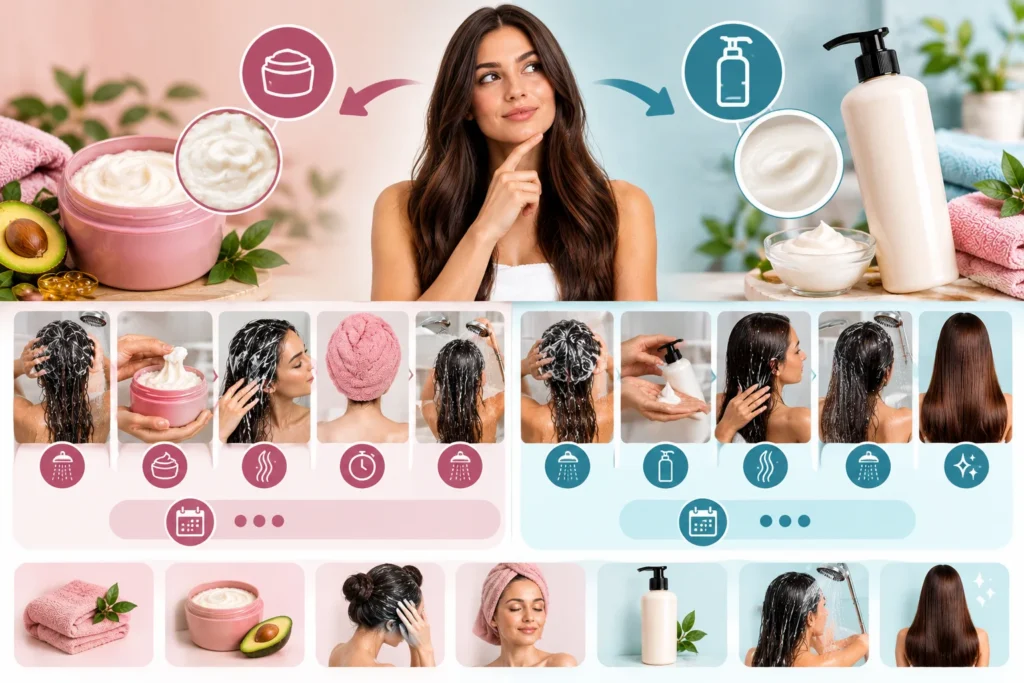
How you use a product is just as important as choosing it. A common mistake is assuming that all products should be used in exactly the same way. In reality, the instructions on each product’s packaging take priority. Generally, conditioner is applied after shampooing and to the hair shaft, while a hair mask is also used according to the product instructions and usually as a complementary care step.
The amount of time the product should remain on the hair, the quantity used, and the frequency of use also depend on the product formula and the condition of the hair. Therefore, instead of providing one fixed number for everyone, the routine should be adjusted according to hair type and the manufacturer’s instructions.
How Should You Use a Hair Mask Correctly?
The Correct Way to Use a Hair Mask
- Wash your hair with shampoo according to your usual routine.
- Gently remove excess water from the hair so the product does not become overly diluted.
- Apply the mask to the hair shaft according to the instructions on the packaging.
- Focus on the areas that are drier or more vulnerable.
- Leave the product on the hair for the specified amount of time.
- Finally, rinse the hair thoroughly.
You should not assume that leaving a hair mask on for a longer period of time will necessarily produce better results. If the product provides specific instructions for how long it should remain on the hair, those instructions should be followed.
Also, in many routines, there is no need to apply a mask directly to the scalp unless the product is specifically designed for this purpose. The main goal of most hair-shaft masks is to care for the hair fiber itself.
How Can You Use Conditioner Without Weighing Down Your Hair?
Conditioner should be used according to the type and thickness of the hair. Using too much product can make fine hair look flat, while thick or curly hair may need a larger amount.
The AAD recommends that for straight and fine hair, conditioner should be applied mainly to the ends, while dry or curly hair can have a greater portion of its length covered.
After distributing the product, the hair can be gently detangled with the fingers or a wide-tooth comb and then rinsed according to the product instructions. Avoid pulling the hair forcefully, especially when it is wet, because hair is more fragile when wet.
Should You Apply a Hair Mask or Conditioner First?
The answer depends on the type of product, and one sequence cannot be determined for all products. Many rinse-out masks are used after shampooing and then rinsed out. If the product instructions also recommend using conditioner, those instructions should be followed.
The most important point is understanding what each product is designed to do. If a mask has strong conditioning properties, using conditioner afterward may not be necessary. If the product provides different instructions, the manufacturer’s instructions take priority.
With regular conditioners, it is also important to note that a product designed to be rinsed out should not be left in the hair unless the manufacturer instructs otherwise. Dermatologist Paradi Mirmirani explains that rinse-out conditioners and leave-in conditioners are not the same in terms of formulation and use.
How Many Times a Week Should You Use a Hair Mask and Conditioner?
For regular conditioner, many people can use it after washing their hair; the AAD also recommends using conditioner after washing.
However, there is no single fixed number that can be given for hair masks for everyone. The appropriate frequency depends on the product formula, hair type, and level of dryness or damage. The best approach is to follow the product instructions and observe how the hair responds.
If the hair becomes heavy, greasy, or flat after use, the amount or frequency of use may be more than necessary. In contrast, if the hair remains dry and difficult to manage, the selected product may not match the hair’s needs.
What Is the Difference Between a Hair Mask and Conditioner? Comparison Table
| Feature | Conditioner | Hair Mask |
|---|---|---|
| Main purpose | Softness and manageability | Complementary and targeted care |
| Place in the routine | Usually after washing | Usually used periodically |
| Frequency of use | Usually more frequent | Usually less frequent or according to product instructions |
| Suitable for | A wide range of hair types | Based on hair needs and product formula |
| Amount of product | Usually less | Depends on the product and hair length |
| Selection based on | Hair type and everyday needs | Hair type and more specific needs |
| Important point | Preventing the hair from becoming weighed down | Following the usage time and instructions |
What Should You Consider When Choosing a Hair Mask or Conditioner?
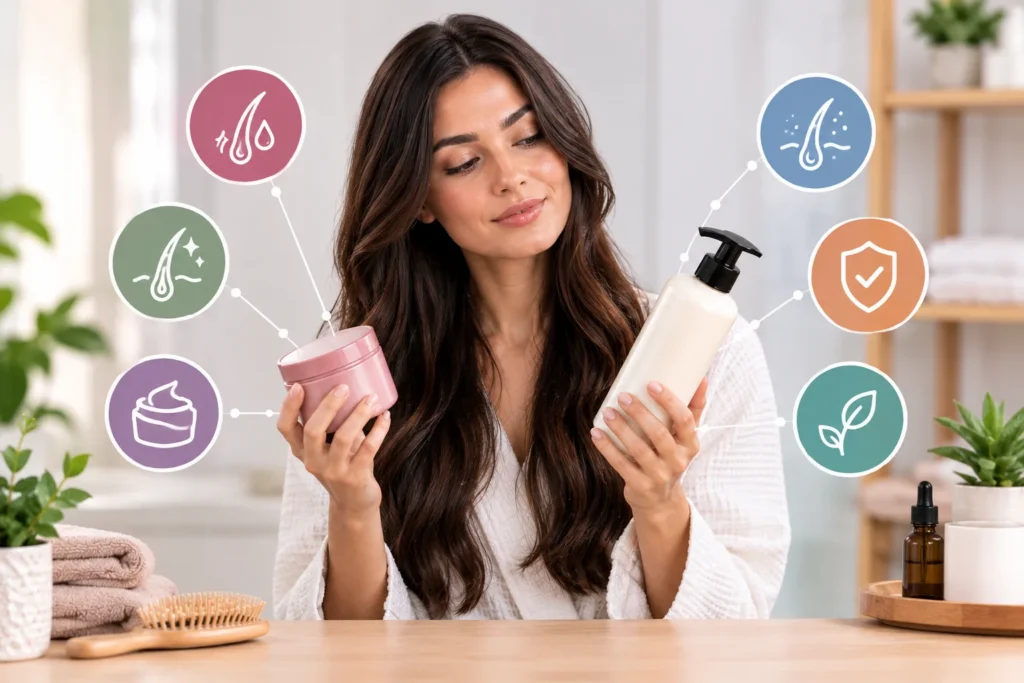
Product selection should not be based solely on advertising or phrases such as “repairing” and “hydrating.” First, determine what the hair actually needs: dryness, frizz, tangling, coloring, curl pattern, fine texture, or a combination of these factors. Then the product formula and usage instructions should be reviewed. The AAD also recommends choosing hair care products according to hair type. For salons and hairstylists, this is even more important because recommending the same product to every client can produce different results. Product selection should be personalized according to the condition of the hair.
What Features Should You Consider When Choosing a Hair Mask?
First, determine the type of need. If the hair is dry, a product designed for conditioning and hydration may be suitable; if the hair is color-treated or affected by heat, a product formulated for these conditions can be selected.
In addition to the claims on the packaging, attention should also be paid to the usage instructions. Some masks are designed for periodic use, while some products may have different characteristics.
The weight of the product should also be appropriate for the thickness of the hair. A product that is suitable for thick hair may feel heavy on very fine hair.
Therefore, there is no single “best hair mask” for everyone; the best option is a product that matches the hair’s actual needs and its usage instructions.
What Matters When Choosing a Conditioner?
The most important criteria are hair type and where the product should be applied. For fine hair, choosing a lightweight formula can help maintain the hair’s shape. For dry or curly hair, a stronger conditioning product or application to a larger portion of the hair shaft may be appropriate.
You should also pay attention to how the product is used. Rinse-out conditioner and leave-in conditioner are not the same and one should not simply be substituted for the other by changing the amount used. The AAD specifically explains that these two types of products differ in formulation and use.
For salons, asking clients a few simple questions about their hair type, level of dryness, color treatment, and heat-styling habits can make product selection more accurate.
What Is the Difference Between a Deep Conditioner and a Hair Mask?
The distinction between a “deep conditioner” and a “hair mask” is not always completely clear because product naming in the market does not follow one universal standard. Some products labeled as hair masks may have a function similar to a deep conditioner, while some deep conditioners may also be formulated for periodic care of the hair shaft.
Therefore, instead of comparing products based only on their names, attention should be paid to the usage instructions, ingredients, leave-on time, and purpose stated by the manufacturer.
This is also important when creating professional content because it is not appropriate to claim solely based on a product name that one category is always stronger or more effective than the other. The actual difference should be evaluated through the product’s formulation and intended use.
When Is It Better to Consult a Specialist About Hair Problems?
If the hair has severe breakage, unusual changes, significant hair loss, or persistent problems, changing the hair mask or conditioner alone may not be enough. Cosmetic products can improve the appearance and manageability of hair, but they do not treat the underlying cause of every hair problem.
The AAD also recommends consulting a qualified dermatologist when persistent hair or scalp problems are present.
This distinction is also important for salon professionals: a hairstylist can provide guidance about cosmetic hair care and suitable product selection, but diagnosing medical conditions of the hair or scalp falls within the scope of medical expertise.
Conclusion
The difference between a hair mask and conditioner is mainly determined by their purpose and their place in a hair care routine. Conditioner is generally used after washing to help soften, detangle, and improve hair manageability, while a hair mask is generally used as more complementary and targeted care.
Neither is universally “the best” for everyone, and the choice should be based on hair type, the condition of the hair shaft, the product formula, and the usage instructions. For many people, combining a suitable conditioner with a periodic hair mask can be part of a hair care routine, but using more products does not necessarily mean better care. At Salomio, this data-driven approach can help salons and beauty professionals provide more personalized recommendations to their clients.
Comments